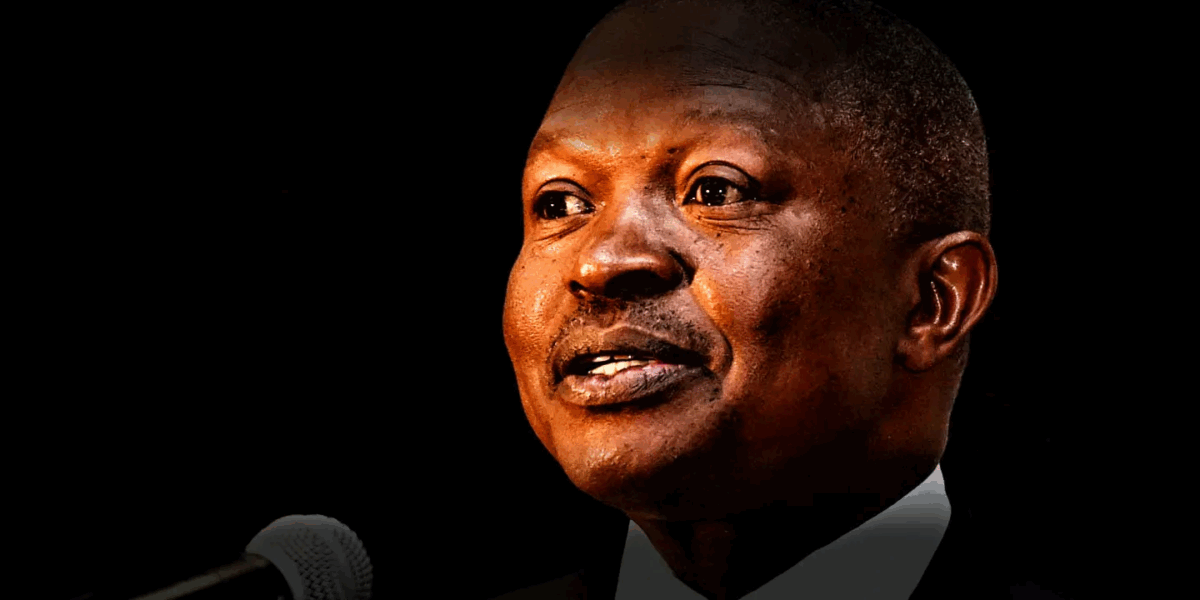
South Africa woke up to the heavy news today — David Dabede Mabuza, the former Deputy President of the Republic and one of the most enigmatic political figures in post-apartheid South Africa, has passed away. He was 64.
Known to many as “The Cat”, a nickname he embraced after surviving multiple political and literal assassination attempts, Mabuza was more than a politician. To some, he was a kingmaker behind the scenes, a shrewd strategist who quietly moved pieces on the chessboard of the African National Congress (ANC). To others, he was a complicated figure, elusive, powerful and deeply rooted in Mpumalanga politics.
But today, those labels fall away. Today, he is simply a man who lived, loved and ultimately left us.
From the Grassroots to the Union Buildings
Born on August 25, 1960, in Phola near Middelburg in the then Eastern Transvaal, Mabuza’s early years were far from glamorous. He was a schoolteacher by training and a youth activist before climbing the political ladder. Those who knew him from back in the day say he was always quiet, always watching, always calculating. “You could tell he wasn’t going to be ordinary,” said one of his childhood friends, Sipho Mahlangu. “David had presence, even back then.”
He later became Premier of Mpumalanga, a position that would both anchor his power base and define much of the mystery around his political dealings. Rumours followed him like a shadow, about his alleged role in political violence, his near-mythical survival of poisonings and the infamous trips to Russia for “medical treatment.” He never directly addressed most of the controversies, choosing instead to let his silence speak volumes.
The Quiet Deputy President
When President Cyril Ramaphosa appointed Mabuza as Deputy President in 2018, it was seen by many as a political compromise. But “DD”, as he was called in political circles, played his part without much noise. He was rarely in the spotlight, often absent from major public events and yet remained one of the most powerful figures in the ANC’s upper echelons. His absence always raised eyebrows; his presence, even more so.
Despite the secrecy that often surrounded him, those close to him paint a different picture. A family man. A devoted father and husband. A man who loved the land, loved Mpumalanga’s hills and valleys and would often retreat to his farm to breathe.
Reactions Pour In
Condolences have been pouring in from across the political spectrum and beyond. President Ramaphosa called him “a loyal comrade and a deeply strategic mind whose contributions to our democracy will not be forgotten.” Former colleagues described him as “a man who understood power, and restraint.” Social media is flooded with tributes, shock and memes, some respectful, others reflective of the controversial figure he was.
But even the jokes and memes are a form of mourning in South Africa, a way we deal with our grief, a way we process those we both admire and critique.
A Legacy Both Complex and Undeniable
David Mabuza’s legacy won’t be easy to define. He was not a Mandela. He wasn’t a Zuma. He wasn’t even a typical politician. He moved differently. Operated in whispers. And yet, whether you loved him or loathed him, you knew he was there.
A man who was never fully understood, never quite trusted, but always respected, even by his critics.
In the end, the cat has finally used up his nine lives. And South Africa, ever dramatic and ever tender, bows its head. Not just for the man he was, but for the reminder that power is fleeting, and that even giants must rest.
Rest in power, DD.
- “I Cuddled Him” — Pearl Thusi Dragged on X After Awkward DJ Warras Memorial Confession

- Tragedy in Jozi: Beloved DJ Warras Fatally Shot in Johannesburg CBD

- South Africa’s Matric Pass-Mark Debate: 30% vs 50% — Why Everyone Is Watching

- Woolworths Drops a New Shopping Bag — Right After Cat Matlala’s “Black Woolies Bag” Bombshell. Coincidence? Mzansi Thinks NOT.

- South Africa Shuts Down As GBVF is Declared a National Disaster